The Mealtime Partner Dining System
This webpage has moved. Your browser should automatically take you there in a couple of seconds. If it doesn't, please click on The Mealtime Partner Dining Device.
The Mealtime Partner (the Partner) serves a wide variety of commonly accepted table foods that are normally eaten with a spoon or fork. Peas, mashed potatoes, breakfast cereal, pudding, fruit cocktail, and other similar foods are all easily served with the Partner. Larger foods like meats, pizza, cookies and salads are also easily served once they are cut into bite size pieces. It can serve a texture controlled diet equally well.
Benefits of Independent Eating:
● Users will experience the pleasure of independence when feeding themselves
● They will select their own food and control the pace at which they eat
● The risk of aspiration and reflux is reduced when the user can choose the pace at which they eat
● Reduces the potential of "learned dependence"
● Not being fed provides an increased capacity for social interaction during the meal (the quiet operation and offset positioning of the Partner enables typical conversation during meals)
● Caregivers will enjoy the reduced effort needed for providing meals and snacks
Advantages of using the Mealtime Partner:
● Easy to use (no complicated coordination of switch activation with lights or sounds)
● Very safe to use (uses a shatterproof plastic spoon and very low spoon extension force)
● Multiple/versatile mounting and positioning methods enable use by any user who is able to chew and swallow normally
● Quick and easy to learn how to setup and use (comes with an instructional video on DVD)
● The Partner is very patient - it will never rush the user (a spoon touch sensor tells the device when the user has finished taking food from the spoon)
● Very reliable operation (will last for many years)
● For children, versatile positioning and adjustable timing allow the Partner to grow with the child into adulthood
● Technical support before and after purchase
The Partner succeeds in providing independent eating for individuals where other devices have failed.
Key Features of the Partner:
● Flexible mounting and positioning meets a diverse range of user needs, including wheelchair users, those who do not sit at a table to eat, and those with skeletal anomalies.
●The Partner can be placed directly on a table using feet or legs, mounted on support shafts, or used with the very versatile Support Arm
● Versatile control system utilizes any standard Adaptive Switches
● Easily serves most ordinary table foods
● Can also serve liquids and texture-controlled foods (soups, cereals, minced, and pureed foods, etc.)
● Reliable food pickup
● Controls the quantity of food on the spoon
● Bottom of the spoon is wiped to minimize dripping
● Three bowls of food can be served at one time. (Separate bowls prevent the food from being mixed.)
● Bowls are quickly and easily interchanged to provide additional food
● Bowls are transparent for easy food identification
● Speed of eating is easily adjusted
● Can serve food at a rate fast enough to satisfy the heartiest of appetites
● Can serve food slow enough to allow time as needed to
chew and swallow
● Spoon will remain extended until the user has finished taking food from the spoon (a spoon touch sensor tells the device when the user is taking food from the spoon)
● Can operate fully automatically or can be controlled with one or two Adaptive Switches selected to suit the user
● For Adaptive Switch users, multiple user switch settings are available to accommodate a wide variety of user needs
● Easy to clean – all surfaces can be wiped
with a damp cloth
● Lightweight and battery powered for portability
● Will serve an entire days meals and
snacks before requiring battery recharging (4.5 hour
maximum recharge time). Partial recharge is OK.
● Comes with one-year warranty parts and labor
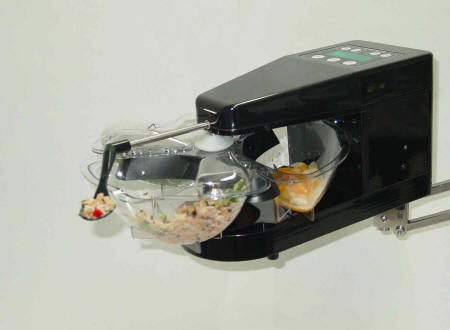
Description of the Mealtime Partner
The Mealtime
Partner dining device (often referred as the
Partner)
is a battery operated robotic assistive device that allows people to feed themselves
without using their arms or hands. The Mealtime Partner increases the user’s independence while lessening their
caregiver’s workload. Food is placed in the three bowls that come
with the Partner. The bowls rotate until the desired food is
located under the spoon.
The
spoon then dips into the bowl, scoops up the food, and presents a
rounded spoonful of food very near the lips of the user.
The user must lean forward slightly and remove the food from
the spoon. This requires a small amount of neck or upper torso
movement.
(Around 1.5 inches,
the length of the bowl of the spoon.)
The Mealtime Partner is designed to accommodate a diverse range of user seating and positioning needs. This is accomplished by mounting the Partner in a variety of ways: on its Support Arm, on a straight Support Shaft (2", 4", 6", 8", and 10" lengths), mounting it on legs (2", 4”, and 6” legs are available), placing it on an over-the-bed hospital table, or, for small children, placing it directly on a dining table.
The Mealtime Partner is positioned in front and to the right of the user (from the user’s perspective). The bowl position and transparent design permits the user to easily view the contents of each bowl during the meal so that they will know what food selections are being offered. The offset positioning provides the user with a clear view of the dining environment and allows functioning in the normal mealtime social setting without their view being blocked.
The Mealtime Partner supports three bowls at one time although extra bowls of food can be prepared and the bowls quickly interchanged as food is eaten during the meal. Each bowl is clear and is designed to serve one cup (0.24 liters) of food. The depth and shape of the bowl provides the proper placement of food on the spoon as it scoops. The use of the appropriate Bowl Cover controls the quantity of food on the spoon. Bowl Covers are available with three different wipe edges: low, medium and high. They accommodate serving diverse food textures and provide for user preferences in the quantity of food served.
The Mealtime
Partner serves a wide variety of foods that are usually eaten with a
spoon or fork. Peas, mashed potatoes, breakfast cereal, pudding,
fruit cocktail, coleslaw, etc. Larger foods like meats, sandwiches,
pizza, cookies, salads, etc., require cutting into bite size
portions so that the spoon can get under and lift them from the
bowl. The bowls are designed to accommodate normal hot or cold foods
and are both dishwasher and microwave oven safe.
Users can control the robotic device using two adaptive switches, one adaptive switch, or fully automatically (using no adaptive switches), according to their functional and/or cognitive needs. The adaptive switches must be selected and positioned to suit the needs of each individual user. To find the most appropriate switches, users may want to investigate the wide variety of switches that are available and can be purchased from many different companies, including Mealtime Partners, Inc. (Mealtime Partners Adaptive Switch selection.)
Most users will operate the Mealtime Partner using
two adaptive switches as this access method offers the greatest
control of the device and the quickest way of moving from one
specific food choice to another. In the two-switch mode, one switch
controls food selection allowing the user to move rapidly from bowl
to bowl, while the second switch controls the spoon movement. The
user has total control of both food selection and the pace at which
each spoonful is served. However, for a few individuals, exerting
effort, even the small amount necessary to activate adaptive
switches, is very demanding. For those users the
Partner can
be operated using one adaptive switch or with no switches.
The automatic mode of operation provides for the
person who either cognitively and/or functionally cannot use an
adaptive switch. It does not require any effort on the part of the
user other than taking the food from the spoon, thus it allows very
frail users who fatigue easily, to conserve their energy. In the
automatic mode the Mealtime Partner bowls rotate to a food selection
and the spoon presents the food to the user. If the user does not
touch the spoon, the food is returned to the bowl it came from, the
bowls rotate to the next food selection, and the spoon serves that
food to the user. This pattern of operation is continued until the
food is taken from the spoon. Once the spoon is touched, the
Mealtime Partner continues to serve that food selection until the
user stops eating that food. When the user stops eating the food, it
is returned to the bowl it came from and the bowls rotate to the
next food selection. The food presentation sequence described above
is restarted.
The Mealtime Partner provides an extremely wide range
of functionality. As a user becomes more proficient, or their
condition worsens, the Mealtime Partner functions can be adjusted to
meet their changing need.
The Mealtime Partner will serve three full meals and
three large snacks before requiring recharging overnight (4.5 hours
maximum recharge time).
(See Optional Mounting Shafts and Optional Legs.) For complete pricing information, see All Products.
The Partner is designed to be accessible to a wide range of users with differing abilities. It has a variety of operational modes that, when combined with adaptive switches, can make the device function in many different ways. This enables the Partner to be utilized by individuals who could not otherwise use equipment controlled by adaptive switches. It is recommended that those users seek the help of an Occupational Therapist, Speech Language Pathologist, or Assistive Technology Practitioner to choose appropriate switches and help determine how the device and the switches should be positioned, and the optimal control settings.
The Mealtime Partner meets the Medicare and Medicaid definitions of Durable Medical Equipment (DME). The United States Food and Drug Administration (FDA) considers the Mealtime Partner to be a Class I type medical device. The Mealtime Partners has successfully completed all governmental electrical safety and electro-magnetic compatibility (EMC) compliance testing. (More about Compliance Testing.)
This page last updated on 6-19-2020
Web Counts: